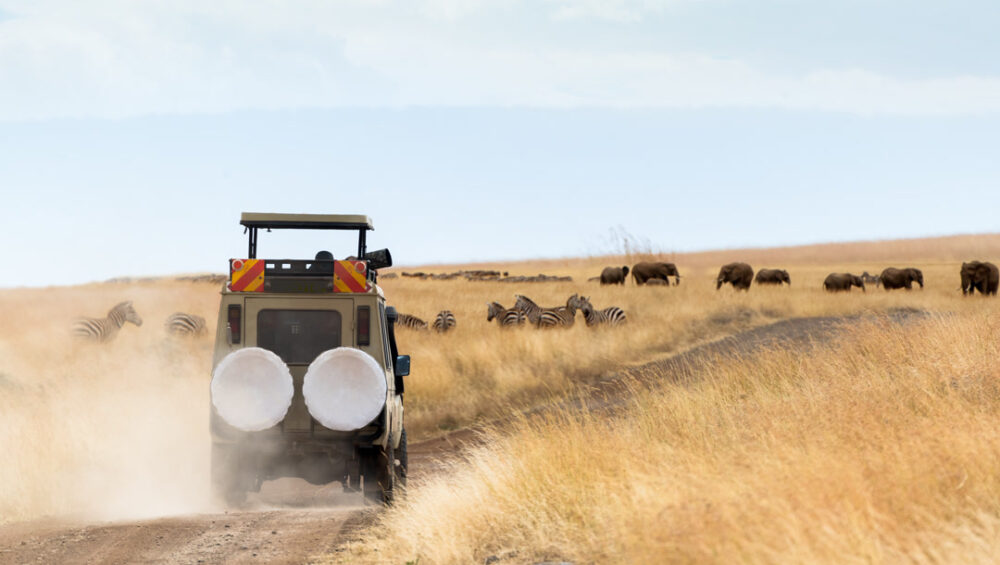
A safari may look effortless from the passenger seat — the vehicle pauses, the engine cuts, and suddenly you are face-to-face with a pride of lions resting beneath an acacia tree. What many guests do not see is the depth of knowledge, observation, and fieldcraft that guides use to locate wildlife in vast, unfenced ecosystems. Tracking animals across landscapes like the Serengeti or Tarangire is not luck. It is skill refined through years of experience.
Professional safari guiding blends ecology, animal behavior science, landscape literacy, and real-time decision-making.
Reading the Landscape
The first principle of tracking is understanding habitat. Different species prefer different terrain, vegetation types, and water access.
In Serengeti National Park, open plains favor cheetahs and large herbivore herds, while riverine corridors attract leopards and elephants. In Tarangire National Park, permanent water sources like the Tarangire River draw wildlife during dry periods. In the Ngorongoro Crater, the enclosed ecosystem supports predictable grazing patterns.
A skilled guide studies these environmental patterns before the engine even starts. Wind direction, recent rainfall, time of year, and grass height all influence where animals are likely to be found.
Wildlife tracking begins with understanding ecosystems — not simply driving and searching.
Interpreting Tracks and Spoor
Animal footprints, known as spoor, provide critical information. Guides identify species by track shape, size, claw marks, stride length, and depth in the soil.
A lion’s rounded paw print differs distinctly from the more oval, claw-visible print of a hyena. Fresh tracks have crisp edges; older tracks soften under wind and sunlight. The direction of movement, speed (walking versus running), and even group size can often be inferred from spoor.
Dung, scent marks, scratch marks on trees, and disturbed vegetation further contribute to the story. Tracking becomes a form of reading the ground as a living record of recent movement.
Observing Animal Behavior
Wildlife tracking is not limited to physical signs. Guides constantly observe behavior patterns.
Predators such as lions and leopards are most active during cooler hours — early morning and late afternoon. Cheetahs prefer open ground with visibility for hunting. Elephants often move between feeding grounds and water in predictable rhythms.
If vultures are circling overhead, it may indicate a fresh kill. If antelope are staring in one direction and snorting alarm calls, a predator may be nearby. Baboons barking from treetops often signal a leopard’s presence.
Professional guides interpret these subtle behavioral cues in real time.
Listening to the Bush
The African wilderness communicates through sound. Alarm calls from impala, zebra, or wildebeest can reveal predator movement. The distinctive whooping of hyenas at dawn may lead to scavenging activity. Even the silence of birds in a particular patch of woodland can indicate disturbance.
Guides train their ears as carefully as their eyes.
The bush is rarely quiet without reason.
Understanding Seasonal Movements
Tracking wildlife in northern Tanzania requires deep knowledge of seasonal migration and water cycles.
The Great Migration in Serengeti National Park follows rainfall patterns, as millions of wildebeest and zebra move in search of fresh grazing. Elephant concentrations in Tarangire National Park increase during dry months when water becomes scarce elsewhere. Resident predators adapt their territories accordingly.
Experienced guides anticipate these shifts and adjust daily routes based on broader ecological rhythms rather than relying solely on chance encounters.
Communication and Team Coordination
While tracking relies heavily on personal expertise, guides also collaborate. Within park regulations, they may communicate with other guides to share general wildlife locations. However, this is supplemental — the foundation remains individual skill and local knowledge.
A professional guide does not depend entirely on radio calls. They confirm sightings independently and evaluate conditions before approaching wildlife to ensure safety and minimal disturbance.
Patience and Positioning
Tracking wildlife is not always about moving forward. Often it requires stopping and waiting.
Positioning the vehicle downwind prevents animals from detecting scent. Approaching slowly avoids triggering flight responses. Anticipating movement paths — such as river crossings or shaded resting areas — allows guides to be in the right place before the action unfolds.
Timing and restraint are critical elements of fieldcraft.
Experience Makes the Difference
Years spent in the bush sharpen intuition. A professional guide learns to recognize patterns invisible to the untrained eye — the way vultures shift direction, the subtle nervousness in a herd, the slight indentation in tall grass where a lion may be resting.
Tracking wildlife is both science and instinct.
It requires ecological understanding, constant observation, deep familiarity with the terrain, and respect for animal behavior. The result is not simply seeing wildlife, but experiencing it in context — understanding why animals are where they are, and how the ecosystem connects.
On safari, every sighting has a story. A professional guide knows how to read it.